
Stage 2 · L11
Define entities, row identity and constraints
Core · original Session 2; extended normalization/cardinality visuals
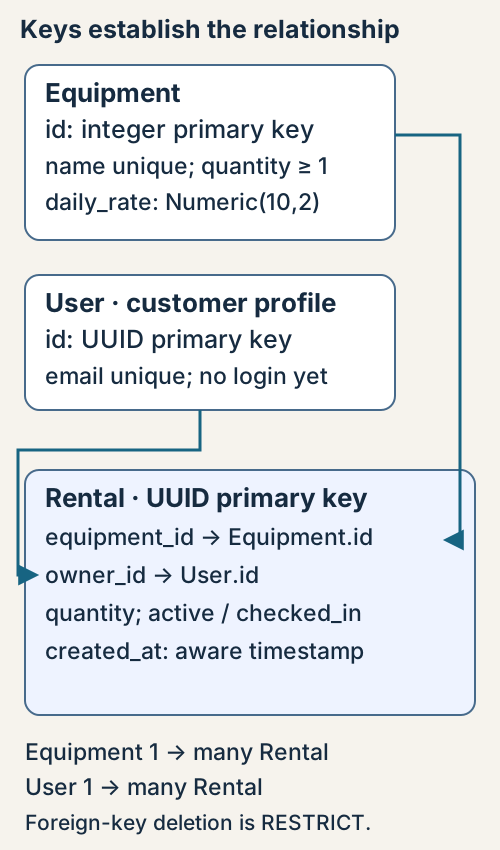
An entity is a kind of fact with an identity. Equipment identifies a catalogue item; User identifies a customer profile; Rental identifies one rental record. At this stage a User row is not a login account and carries no password. The name is retained to align the later authenticated owner relationship; authentication arrives in stage 06.
Equipment.id is an integer primary key generated by PostgreSQL. User.id and Rental.id are UUIDs generated by the application default when a row is inserted. A primary key uniquely identifies a row and cannot be null. Equipment.name and User.email have separate uniqueness rules: a name is not the equipment identity, and a uniqueness rule can reject a second row even when its primary key differs.
Rental.equipment_id and Rental.owner_id are foreign-key columns. PostgreSQL checks that those values refer to existing equipment and customer rows. The Rental.equipment relationship is an ORM navigation declaration, not another stored column. It does not replace the foreign key. A direct SQL writer that never uses Python relationships is still constrained by the database.
Quantity must be at least one and daily_rate must be nonnegative. Input validation later gives clients readable errors, but database CHECK and NOT NULL constraints protect other writers too. The baseline submits raw SQL that bypasses Pydantic and proves each constraint rejects an invalid row. Numeric(10,2) stores bounded decimal money; use Decimal rather than binary floats for the request and model boundary.
Deletion is restricted for referenced equipment/customer rows. Rental history must not disappear because somebody deletes a catalogue item. An ORM cascade or delete-orphan rule controls session behavior; ON DELETE CASCADE controls database behavior for all writers. This schema deliberately uses neither destructive cascade for business history. Choose a policy based on the fact's ownership and retention requirements, not to silence a foreign-key error.
passive_deletes='all' tells SQLAlchemy not to null the child references when equipment is deleted. PostgreSQL then applies its RESTRICT foreign key. Without that ORM setting, a parent delete can first attempt an invalid NULL update and report a different constraint failure; the stage09 regression review caught and corrected that behavior.
For the raw SQL exercise, INSERT INTO equipment(name, quantity, daily_rate) names the target columns; VALUES supplies one matching tuple. Quoted text and numeric values have different SQL syntax. SELECT lists the columns to read FROM that table, and ORDER BY id makes this simple inspection deterministic. The deliberately invalid INSERT demonstrates stored constraints without a Pydantic request or a Session implementation.
Follow the running code
Focused lesson example; see the end-of-stage capstone for the cumulative app · stage 02
INSERT INTO equipment(name, quantity, daily_rate)
VALUES ('Invalid stock', 0, 5);
-- quantity CHECK rejects this row.
SELECT id, name, quantity, daily_rate FROM equipment ORDER BY id;
Predict and observe this focused example using the concepts explained above. Its boundary is stated in the focused answer.
Guided lab
- Read the explanation and predict the focused example’s outcome.
- Predict the constraints rejecting quantity=0, duplicate Tripod, NULL name and a rental referencing a missing equipment ID.
- Compare the observed outcome with the focused answer and state its boundary.
Expected: quantity=0 violates CHECK; a duplicate catalogue name violates UNIQUE; NULL name violates NOT NULL; a missing parent violates the FOREIGN KEY. The primary key identifies a row independently of its display name. Decimal money is distinct from binary float. This answer does not implement a session or related insert.
- Invalid quantity, negative rate or a missing referenced key is rejected by the stored constraint; it is not a successful insert.
Focused exercise and answer
Complete this focused exercise before reading its answer. The full native transfer is introduced only at the end of the stage.
Your transfer task: Predict the constraints rejecting quantity=0, duplicate Tripod, NULL name and a rental referencing a missing equipment ID.
- Predict the constraints rejecting quantity=0, duplicate Tripod, NULL name and a rental referencing a missing equipment ID.
Inspect the matching answer
This answer addresses the focused exercise above; the cumulative implementation is shown only after the stage prerequisites.
quantity=0 violates CHECK; a duplicate catalogue name violates UNIQUE; NULL name violates NOT NULL; a missing parent violates the FOREIGN KEY. The primary key identifies a row independently of its display name. Decimal money is distinct from binary float. This answer does not implement a session or related insert.Check your reasoning
Does relationship() enforce referential integrity for direct SQL?
Show the explanation
No. The database foreign-key constraint enforces it; relationship() supplies ORM navigation and load behavior.
Reading progress
54 lessons remain open to guests. Marking a lesson read records reading only; it does not award assessment credit or a certificate.
Device reading marks require browser storage. Reading is always available.
Sign in or create an account to save separate account progress. Your current page is kept.
Your earlier place on this device suggests these lessons. No new lesson is marked read.