
Stage 9 · L45
Assert protected effects, database rollback and coverage limits
Core · original Session 9
Download starter · Download solution
Use the starter for this stage's focused examples. The cumulative transfer and solution belong at the stage-end capstone. Baseline checks pass; transfer checks initially fail. Downloads contain the matching native starter and solution for this stage.
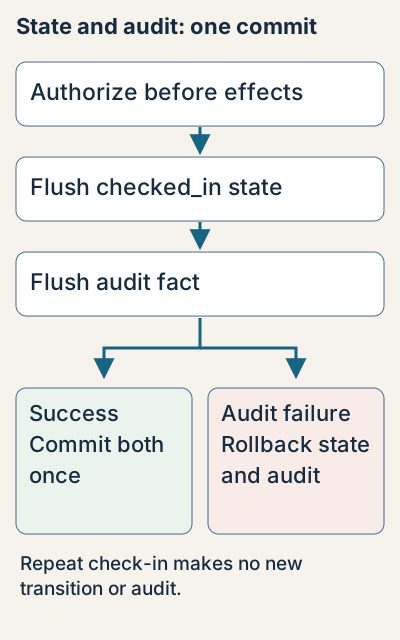
The stage-end capstone combines a protected state transition with an audit fact. A successful active→checked_in change must create exactly one AuditEvent in the same transaction. Repeat check-in returns the completed state without another audit. A forbidden customer action must leave the rental active and create no audit.
The service first flushes the rental state change, then adds/flushes AuditEvent before transaction exit. The audit action has a real database CHECK. The failure fixture changes the second write's action to invalid, producing an actual PostgreSQL constraint error after the first UPDATE was sent. The context rolls back both; a fresh session confirms active state and zero audit rows.
This is stronger than mocking session.rollback or looking at the same session's object. The first write actually reached PostgreSQL within a transaction, and another session sees its rollback. The public response is a safe500 internal_error rather than exposing the constraint SQL. Expected uniqueness/reference conflicts remain409 through the narrowed error classification.
Coverage measures executed lines/branches under a defined run; it does not prove assertions are meaningful, roles are complete, every race is covered or production resources work. The source supplement's80% example is a gate proposal, not a universal threshold or a passing result here. Review the permission/state/side-effect matrix and the actual fresh-session assertions.
Audit history is a synthetic teaching entity. Its foreign keys restrict deletion; production audit retention, account deletion/anonymization and erasure replay are not decided by this exercise. Do not publish this schema as if those legal/product decisions were approved. The public website's certificates and existing progress IDs remain untouched.
Savepoint isolation is a direct-service test technique. Begin one outer transaction on an explicitly owned connection, bind Session to it with join_transaction_mode="create_savepoint", and let the service finish its inner transaction. Its successful commit releases the savepoint, while outer.rollback still removes the test effect. Close the session before rolling back and verify from a fresh connection afterward.
This fixture isolates only operations using that bound connection. A service opening a new engine/session/connection escapes the outer transaction, and sharing this connection across unrelated concurrent tasks is unsafe. Actual API/failure/concurrency checks here keep disposable PostgreSQL fixtures and fresh observers; they do not claim savepoints enclose an arbitrary whole application.
Follow the running code
Focused lesson example; see the end-of-stage capstone for the cumulative app · stage 09
with engine.connect() as connection:
    outer = connection.begin()
    session = Session(bind=connection, join_transaction_mode='create_savepoint')
    try:
        service_result = services.create_equipment(session, payload)
        # Service completion releases its savepoint, not the outer transaction.
    finally:
        session.close()
        outer.rollback()
# A fresh connection verifies the test write did not persist.
Predict and observe this focused example using the concepts explained above. Its boundary is stated in the focused answer.
Guided lab
- Read the explanation and predict the focused example’s outcome.
- Explain what the outer transaction can isolate and what an escaping connection cannot. Then complete the separately shown atomic-audit stage capstone.
- Compare the observed outcome with the focused answer and state its boundary.
Expected: The bound session joins through savepoints, so a service commit releases its inner savepoint while the outer test transaction still owns rollback. A fresh connection after outer rollback sees no test row. A service opening a different connection escapes that fixture, so actual API rollback tests retain disposable databases/fresh observers. Coverage counts execution, not assertion quality. The capstone separately proves state/audit rollback through a real second-write failure.
- A mocked rollback or same-session object is insufficient; audit retention/deletion remains an explicit production decision.
Focused exercise and answer
Complete this focused exercise before reading its answer. The full native transfer is introduced only at the end of the stage.
Your transfer task: Explain what the outer transaction can isolate and what an escaping connection cannot. Then complete the separately shown atomic-audit stage capstone.
- Explain what the outer transaction can isolate and what an escaping connection cannot. Then complete the separately shown atomic-audit stage capstone.
Inspect the matching answer
This answer addresses the focused exercise above; the cumulative implementation is shown only after the stage prerequisites.
The bound session joins through savepoints, so a service commit releases its inner savepoint while the outer test transaction still owns rollback. A fresh connection after outer rollback sees no test row. A service opening a different connection escapes that fixture, so actual API rollback tests retain disposable databases/fresh observers. Coverage counts execution, not assertion quality. The capstone separately proves state/audit rollback through a real second-write failure.Stage 09 capstone — after these prerequisites
Implement exactly-once state/audit under one transaction; repeat/denial have no extra effect and real second-write failure rolls back both.
Use the downloaded starter after completing this stage's focused exercises. The cumulative implementation below is a stage transfer answer, not an answer to an earlier lesson.
python run_checks.py --stage 09 --role starter --prepare
python run_checks.py --stage 09 --role starter
python run_checks.py --stage 09 --role starter --transfer
From this extracted starter: preparation and baseline pass; transfer initially fails only at the named unfinished target. After implementing it, rerun the same starter --transfer command and expect success.
Optional comparison in a separate solution directory
Optional comparison: download and extract this stage’s solution ZIP into a separate directory. Change your terminal into that extracted solution root (beside checkpoint.json and run_checks.py) before running the following commands. Your starter remains a starter even after you implement its task.
python run_checks.py --stage 09 --role solution --transfer
Inspect the cumulative capstone implementation
@requires_permission("rental", "check_in")
def check_in(session, rental_id, actor):
    with session.begin():
        # Resolve immutable parent identity, then use the same parent lock order as reserve.
        equipment_id = session.scalar(select(Rental.equipment_id).where(Rental.id == rental_id))
        if equipment_id is None:
            raise DomainError(404, "rental_missing", "Rental not found")
        session.scalar(select(Equipment).where(Equipment.id == equipment_id).with_for_update())
        rental = session.scalar(select(Rental).where(Rental.id == rental_id).with_for_update())
        if rental.status == "active":
            rental.status = "checked_in"
            session.flush()
            session.add(AuditEvent(rental_id=rental.id,actor_id=actor.id,action="checked_in"))
            session.flush()
        output = RentalOut.model_validate(rental)
    return output
Check your reasoning
What proves the two-write operation is atomic?
Show the explanation
A real second-write database failure after the first flush, followed by an independent session reading the unchanged rental and zero audit rows.
Reading progress
54 lessons remain open to guests. Marking a lesson read records reading only; it does not award assessment credit or a certificate.
Device reading marks require browser storage. Reading is always available.
Sign in or create an account to save separate account progress. Your current page is kept.
Your earlier place on this device suggests these lessons. No new lesson is marked read.