Stage 6 · L27
Understand bearer tokens, JWT claims and trusted verification
Core · original Session 6
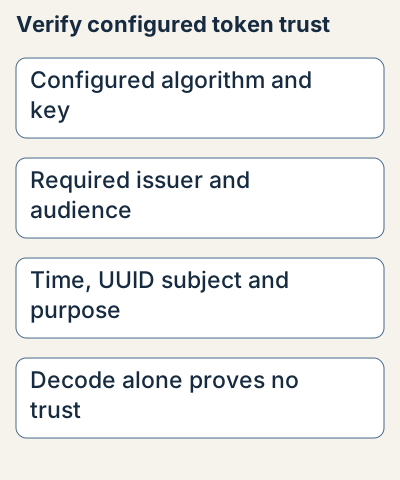
A JWT is a signed claims container. Its readable encoded body is not encryption, and seeing a plausible sub string does not establish trust. The server validates the signature under an explicit HS256 allowlist and a fresh local secret before interpreting claims. The key is never accepted from the incoming token.
This revision requires issuer, audience, subject, issued-at, not-before, expiry, token_use and credential version. sub must parse as a UUID; cv must be an integer rather than a boolean or arbitrary string. Access, verification and reset tokens have distinct purposes. The source Session06 uses a different integer-identity example; the Equipment revision retains UUIDs and adds a current-version check deliberately.
An expired token, bad signature, wrong audience/issuer, missing required claim, malformed UUID, wrong purpose or incorrect version must fail closed. The native matrix signs deliberately altered fixture claims and verifies401; merely decoding a JWT without signature checks would make those tests succeed incorrectly. Do not paste a live token into a lesson, log or online decoder.
Tokens are short-lived, but revocation needs current state too. This course does not build a refresh-token service or session inventory. Verification/reset increments the stored credential version, and current_actor reloads active/version per request. Federated issuer discovery, JWKS rotation and refresh rotation are distinct optional concepts later; local HS256 is not advertised as OIDC.
The Authorization request header carries Bearer plus the access token. The API's401 challenge tells a caller that authentication is required. A browser preflight or signed token does not imply an authorized action. The next stage checks the current stored role and record ownership rather than trusting a role supplied by the caller.
Symmetric signing such as HS256 shares one secret between signer and verifier; any holder capable of verifying with that secret can also sign. Asymmetric signing uses a private signing key and a public verification key, allowing verifiers to avoid holding the private signer. The algorithm and key trust policy come from reviewed configuration. Do not accept an algorithm or arbitrary verification location merely because an incoming token names it.
JWT describes claims; JWS describes a signed payload format. The local compact JWT is represented as a JWS with protected header, payload and signature. Base64url decoding exposes text without establishing trust. JWK is a JSON representation of a key; JWKS is a set of such keys. A key identifier chooses among already trusted keys and is not authorization. This core actually implements HS256; asymmetric/JWK/JWKS are explained boundaries with no installed key-fetch endpoint.
An identity-provider ID token describes a sign-in to its intended client; it is not the API access credential required by this local endpoint. Different purpose and audience are rejection boundaries even when a token is otherwise signed. Later optional protocol lessons explain the full provider flow; this core exercise uses only the local access-token verifier.
Follow the running code
Focused lesson example; see the end-of-stage capstone for the cumulative app · stage 06
JWT: a claims representation
JWS: a signed payload representation (the local compact JWT is a JWS)
HS256: one shared secret signs and verifies
Asymmetric: private key signs; public key verifies
JWK: a structured key; JWKS: a set of keys
Decode ≠ verify signature + issuer + audience + purpose + time.
Predict and observe this focused example using the concepts explained above. Its boundary is stated in the focused answer.
Guided lab
- Read the explanation and predict the focused example’s outcome.
- Classify a tampered token, wrong issuer/audience, ID token sent to this API and an unknown key. Explain which key is permitted to verify local access.
- Compare the observed outcome with the focused answer and state its boundary.
From the extracted stage starter root, after completing its README setup:
python run_checks.py --stage 06 --role starter --walkthrough login
Expected: The local verifier accepts only its configured HS256 key/algorithm and required access claims, not a token-selected algorithm/key/issuer. Tamper, wrong issuer/audience/purpose and expired/missing claims reject. Asymmetric signing separates private signer and public verifier, but no asymmetric/JWKS endpoint is installed. A JWK describes a key, not trusted authorization; an ID token is not this API access token.
- JWT body is readable; omitted signature/audience/purpose checks permit invalid trust decisions.
Focused exercise and answer
Complete this focused exercise before reading its answer. The full native transfer is introduced only at the end of the stage.
Your transfer task: Classify a tampered token, wrong issuer/audience, ID token sent to this API and an unknown key. Explain which key is permitted to verify local access.
- Classify a tampered token, wrong issuer/audience, ID token sent to this API and an unknown key. Explain which key is permitted to verify local access.
Inspect the matching answer
This answer addresses the focused exercise above; the cumulative implementation is shown only after the stage prerequisites.
The local verifier accepts only its configured HS256 key/algorithm and required access claims, not a token-selected algorithm/key/issuer. Tamper, wrong issuer/audience/purpose and expired/missing claims reject. Asymmetric signing separates private signer and public verifier, but no asymmetric/JWKS endpoint is installed. A JWK describes a key, not trusted authorization; an ID token is not this API access token.Check your reasoning
Why should a JWT's advertised algorithm not choose the accepted algorithm?
Show the explanation
The verifier's trusted configuration sets the allowlist. Incoming data cannot choose its own trust mechanism.
Reading progress
54 lessons remain open to guests. Marking a lesson read records reading only; it does not award assessment credit or a certificate.
Device reading marks require browser storage. Reading is always available.
Sign in or create an account to save separate account progress. Your current page is kept.
Your earlier place on this device suggests these lessons. No new lesson is marked read.