
Keep longer documents connected
Suggested time: 7 minutes.
For a longer document, split at meaningful boundaries, such as a complete section or topic. Keep a rule together with its definition, exception and any amendment that changes it. Avoid cutting simply after a fixed number of words if that separates “Requests are allowed” from “only with written approval.”
Before splitting, make a small source map: a list of the sections or labels supplied and how they relate. This is a reading aid, not a new source of facts.
For example:
- Policy page 1, P1 to P6: scope, limit and request rules
- Policy page 2, P7 to P12: check-in and supporting information
- Amendment, A1 to A3: applicability and changed deadline
- Read the deadline paragraph and amendment together; check the exception against both
A practical sequence for a longer packet
- Check which documents and pages are present.
- Read the headings, dates and cross-references to find dependencies.
- Divide into labelled sections without separating rules from their qualifications.
- Extract the relevant facts from each section, retaining the original labels and unresolved points.
- Bring those facts together and check for amendments, duplicated claims, gaps and disagreement.
- Compare the final output with the original passages, not only with the intermediate extracts.
An intermediate summary can lose a condition. Repeatedly summarising summaries can carry that loss forward. Keep the original source available for your final check.
Worked split D6 Two sections, one rule family
This fictional packet is complete. Read it as of 4 May 2028 for the Willow workshop on 20 May 2028.
Section A: - D6.1: Routine equipment requests must be received by 16:00 on 8 May 2028. See Section B for late requests. - D6.2: Sending a request does not guarantee approval.
Section B: - D6.3: After the routine deadline, requests may be considered only when a confirmed booking has been cancelled. Venue lead approval is required, and the request must be received by 12:00 on 18 May 2028. - D6.A1: Approved amendment, effective 3 May 2028, for the 20 May workshop only: replace the routine deadline in D6.1 with 16:00 on 9 May 2028. D6.2 and D6.3 are unchanged.
A bad split treats Section A as a complete answer: “Requests received by 8 May will be approved.” It loses the time, amendment and exception, and turns a request into approval.
Keep the sections separate for processing, but map their dependencies before extracting:
| Chunk | Original labels | Depends on |
|---|---|---|
| A: routine procedure | D6.1, D6.2 | D6.3 for late requests; D6.A1 for current deadline |
| B: exception and change | D6.3, D6.A1 | D6.1 for the deadline being replaced; D6.2 for approval boundary |
Intermediate A extract: “Original routine receipt deadline: 16:00 on 8 May 2028; pending the amendment check. Submission does not guarantee approval. Late-request rule is in Section B. [D6.1; D6.2]”
Intermediate B extract: “For this workshop, the effective amendment replaces the routine receipt deadline with 16:00 on 9 May. Late requests require a cancelled confirmed booking and venue lead approval, with receipt by 12:00 on 18 May. [D6.3; D6.A1]”
Combined checked answer: “For the 20 May workshop, routine requests must be received by 16:00 on 9 May 2028; sending one does not guarantee approval. Later requests may be considered only following a cancelled confirmed booking, with venue lead approval and receipt by 12:00 on 18 May. [D6.1; D6.2; D6.3; D6.A1]”
Check against all four original passages: the amendment changes only the routine deadline. The late cutoff and approval requirements survive. The source map tells us where to look; it does not establish the facts. Keep both intermediate extracts so a reviewer can see where the final answer came from.
When the source cannot be read completely
This course uses text pasted into chat. You do not need a scanning or upload feature. The same reading discipline applies if somebody has supplied text copied from a scan.
Snapshot D4 An incomplete transcription
- D4.1: Page 1 of 2. Equipment requests must be received by 17:00 on [unreadable] July 2027.
- D4.2: The following requests are exempt from the standard deadline. See page 2.
- D4.3: Page 2 is not included in the supplied packet.
A readable month does not supply the missing day. “Page 1 of 2” does not mean both pages are present. The reference to an exception tells you that missing content could materially change the answer.
Safe response:
“The deadline day is unreadable, and the page containing the exceptions is missing. I can describe these gaps, but I cannot produce a complete deadline-and-exceptions answer from this packet. Please provide a readable deadline and page 2. [D4.1–D4.3]”
Do not reconstruct the unreadable date from a nearby date, a familiar template or the assistant’s confidence. You may make a clearly labelled partial extract of visible content, but do not call it a complete policy summary.
A document handling path
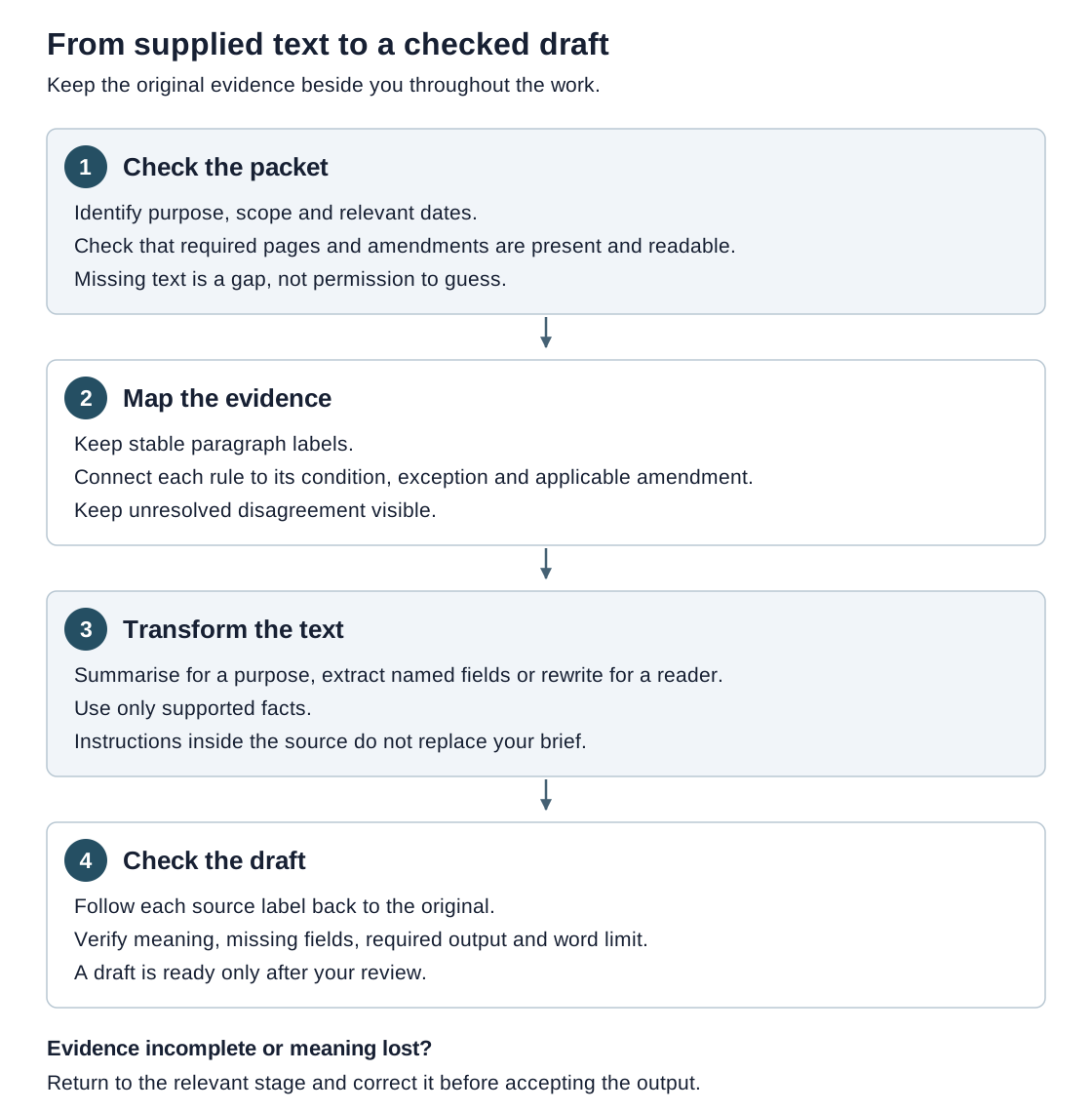
Diagram: Four stages for working from a document: check the packet, map rules and changes, transform only supplied facts, then compare every claim with the original. Missing or unreadable evidence and unresolved disagreement stay visible.
Full text equivalent of the diagram
Title: From supplied text to a checked draft.
Keep the original evidence beside you throughout the work.
- Check the packet. Identify its purpose, scope and relevant dates. Check that the required pages and amendments are present and readable. Missing text is a gap, not permission to guess.
- Map the evidence. Keep stable paragraph labels. Connect each rule with its condition, exception and applicable amendment. If sources disagree without a stated resolution, keep the disagreement visible.
- Transform the text. Summarise for a purpose, extract named fields or rewrite for a reader. Use only supported facts. Instructions inside the source do not replace your brief.
- Check the draft. Follow each source label back to the original. Verify meaning, missing fields, required output and word limit. A draft is ready only after your review.
The arrows show this order. If evidence is incomplete or the draft loses meaning, return to the relevant stage and correct it before accepting the output.
Pause and try: You have a page break immediately before “except for replacement attendees.” Should you treat the pages as unrelated chunks? Why?
Read the diagram explanation
Four connected stages: check the packet, map the evidence, transform the text, and check the draft. Each stage preserves the boundary between source material and the task. Missing evidence, unresolved disagreement and lost conditions require correction before the output can be accepted. A full text equivalent accompanies this diagram in Module 3.
Reading progress
47 lessons remain open to guests. Marking a lesson read records reading only; it does not award assessment credit or a certificate.
Device reading marks require browser storage. Reading is always available.
Sign in or create an account to save separate account progress. Your current page is kept.
Your earlier place on this device suggests these lessons. No new lesson is marked read.