
Organise actions and simple data
Module 6 Organise actions and simple data
Meeting notes mix things people agreed to do, decisions already made and ideas that nobody has accepted. A useful task register separates them. A useful number makes clear what was counted, what was excluded and how missing information was handled.
In this module, you will turn fictional workshop notes into a complete task register. You will keep the original values, record proposed corrections and calculate a completion percentage that another person can reproduce.
What you will learn
By the end, you will be able to:
- Distinguish an agreed action from a decision or suggestion.
- Record an action, owner, due date, dependency and status without filling gaps by guesswork.
- Explain what one table row represents and what the columns and units mean.
- Identify an exact duplicate, missing values and inconsistent status labels while preserving the original records.
- Reconcile every source entry and produce a complete 12-row task register.
- Count completed tasks and calculate a percentage using an explicit inclusion rule and denominator.
Before you start
Complete Modules 1 to 5 first, or check that you can separate instructions from source notes, preserve missing information and verify both claims and arithmetic. Keep your source-checking method from Module 4 nearby.
Use an approved ordinary text-chat assistant, a document or notebook, and a calculator. A plain text table is sufficient. No spreadsheet subscription, upload, connected app, formula language or coding is required. Use only the supplied fictional material, and keep all proposed changes in your practice document.
Allow about 90 minutes: five lessons and demonstrations, 30 minutes; guided practice, 30 minutes; independent assignment, 20 minutes; self-check and answer review, 10 minutes. These are planning estimates.
Continue the workshop scenario
You support the fictional Willow Team preparing a community workshop. Each pack is a separate snapshot. Use only the named pack for the current task, even if a person’s name appears elsewhere. All people, dates and operational details are invented.
Example responses are illustrative teaching examples, not recorded live-tool results. If no approved chat tool is available, extract and review the records yourself and label the work as offline practice. The counting and source checks still apply.
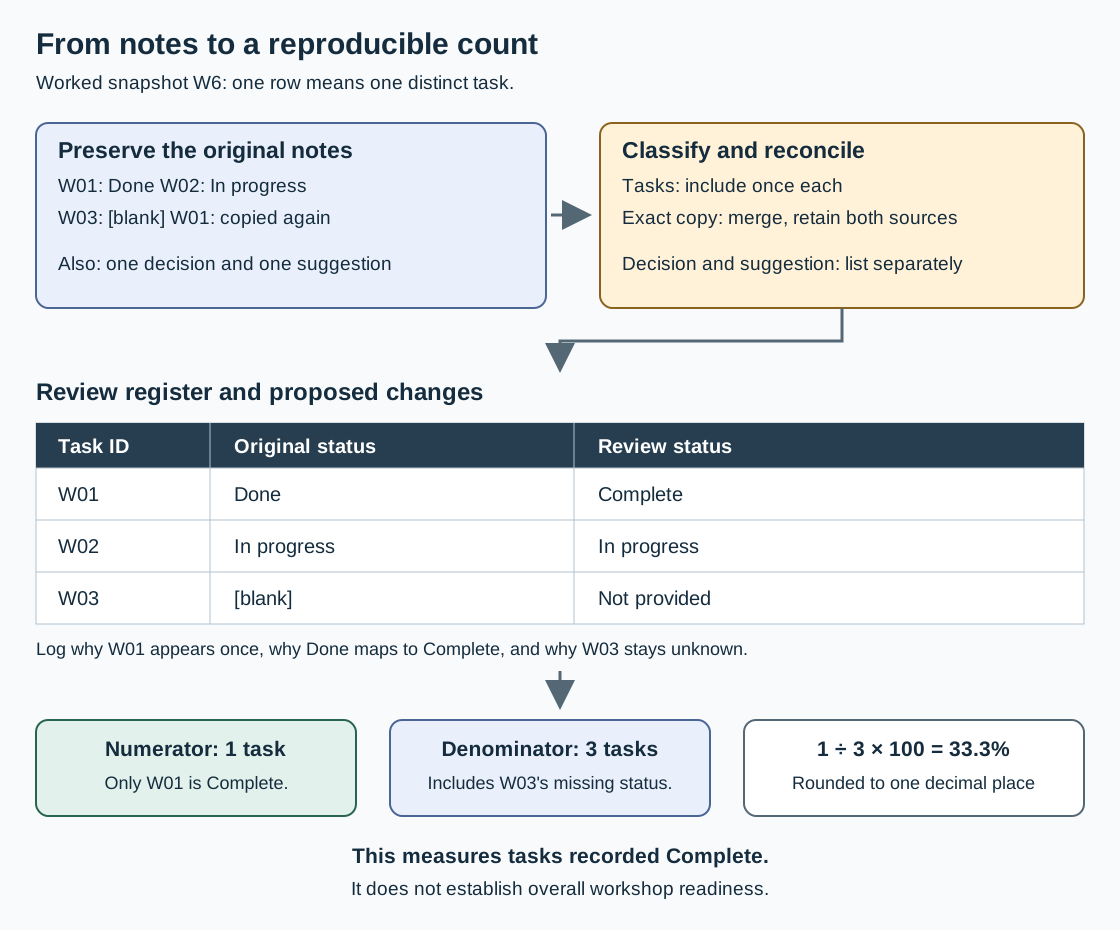
Read the diagram explanation
Worked snapshot W6 has four task mentions, including a repeated W01, plus a decision and a suggestion. Reconciliation produces three distinct task rows. W01 is Complete, W02 is In progress and W03 has missing status. Originals and proposed changes are retained. The completed count is one; the denominator is three and includes the missing-status task. One divided by three times one hundred is 33.3 percent to one decimal place.