
Adapt the form while keeping the meaning
Suggested time: 7 minutes.
Different forms can select and order facts differently. They must not contradict each other. A short draft may omit an irrelevant detail, but it must keep any condition needed to understand the detail it includes.
An internal update usually leads with status and what needs attention. An email draft names a recipient and focuses on one purpose or request. An FAQ uses questions a reader would reasonably ask, followed by direct answers.
Three drafts from worked snapshot W5
Internal update:
- Room: Cedar Room is confirmed for 12 June 2030, 10:00 to 11:00. The projector is unconfirmed. [W5.1]
- Handout: Draft complete; wording review pending and distribution unapproved. [W5.2, W5.4]
- Next steps: Mira agreed to ask about the projector by 8 June. Lee agreed to review wording by 9 June. [W5.3, W5.4]
Email draft for review
Recipient: Mira, the fictional workshop coordinator. This routing note is outside the draft.
Subject: Projector status for the workshop
Hi Mira,
Cedar Room is confirmed for 12 June 2030, 10:00 to 11:00, but the projector is unconfirmed. [W5.1] You agreed to ask the venue about it by 8 June. [W5.3] Please confirm the projector position when a reply is available. [W5.5]
Thanks, Willow Team
FAQ draft for fictional volunteers:
Where and when is the workshop? Cedar Room is confirmed for 12 June 2030, from 10:00 to 11:00. [W5.1]
Will there be a projector? Projector availability is not confirmed. Mira agreed to ask the venue by 8 June; no response date is promised. [W5.1, W5.3]
Can we distribute the handout? Distribution has not been approved. The draft is complete, and Lee agreed to review its wording by 9 June. [W5.2, W5.4]
These forms have different jobs. The email does not need to repeat every handout detail because its purpose is the projector question. It does need to keep the projector uncertainty. None of the drafts says that a message was sent.
One fact set three useful forms
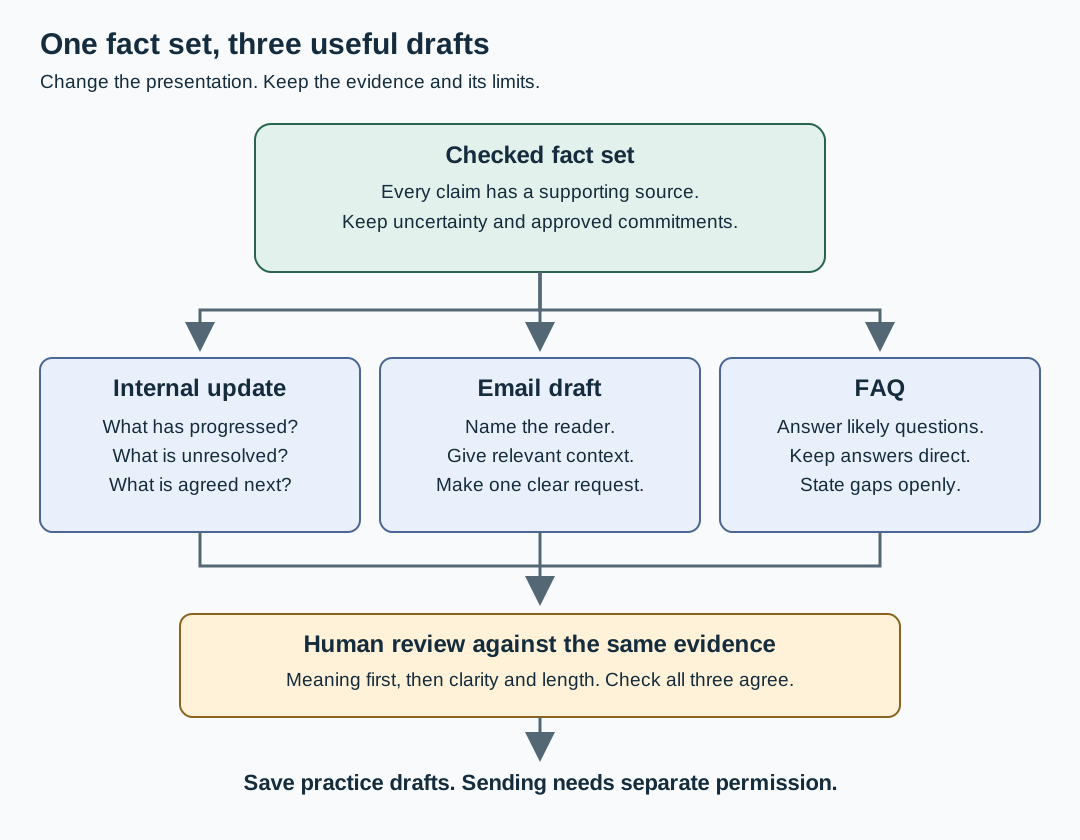
[A checked fact set branches into an internal update, an email draft and an FAQ. Each carries the same facts, conditions and approved commitments, then passes a human check before being saved as a practice draft.]
Text equivalent of the diagram
- Start with a checked fact set. Each claim has a source, any uncertainty and only the commitments people actually approved.
- For an internal update, select status, unresolved items and agreed next steps.
- For an email draft, select context needed by the named recipient and one clear request.
- For an FAQ, select likely questions and answer only what the evidence supports; state gaps openly.
- Check all three against the same fact set. Facts, uncertainty and approved commitments stay consistent even when tone, order and length change.
- Save the reviewed practice drafts. Drafting and reviewing do not authorise sending or publishing.
Read the diagram explanation
A checked fact set containing sources, uncertainty and approved commitments branches into an internal update for status, an email draft for one request and an FAQ for practical questions. The three drafts converge at a human check of meaning, clarity and length. The result is saved as practice drafts; sending is a separate decision.
Reading progress
47 lessons remain open to guests. Marking a lesson read records reading only; it does not award assessment credit or a certificate.
Device reading marks require browser storage. Reading is always available.
Sign in or create an account to save separate account progress. Your current page is kept.
Your earlier place on this device suggests these lessons. No new lesson is marked read.