
Reconcile the whole pack and check the result
Suggested time: 6 minutes.
A tidy table can still be incomplete. Reconciliation means accounting for every source entry and showing where it went: a register row, a merged duplicate reference, a decision list or a suggestion list.
Use this sequence:
- Preserve the original source pack.
- Classify every entry before extracting tasks.
- Make one row per distinct task and retain supporting source labels.
- Keep original values beside proposed standard values; log duplicates and missing fields.
- Check coverage, then count with the agreed rule.
- Verify the arithmetic with a calculator and write a result that names the unit and missing data.
From notes to a reproducible percentage
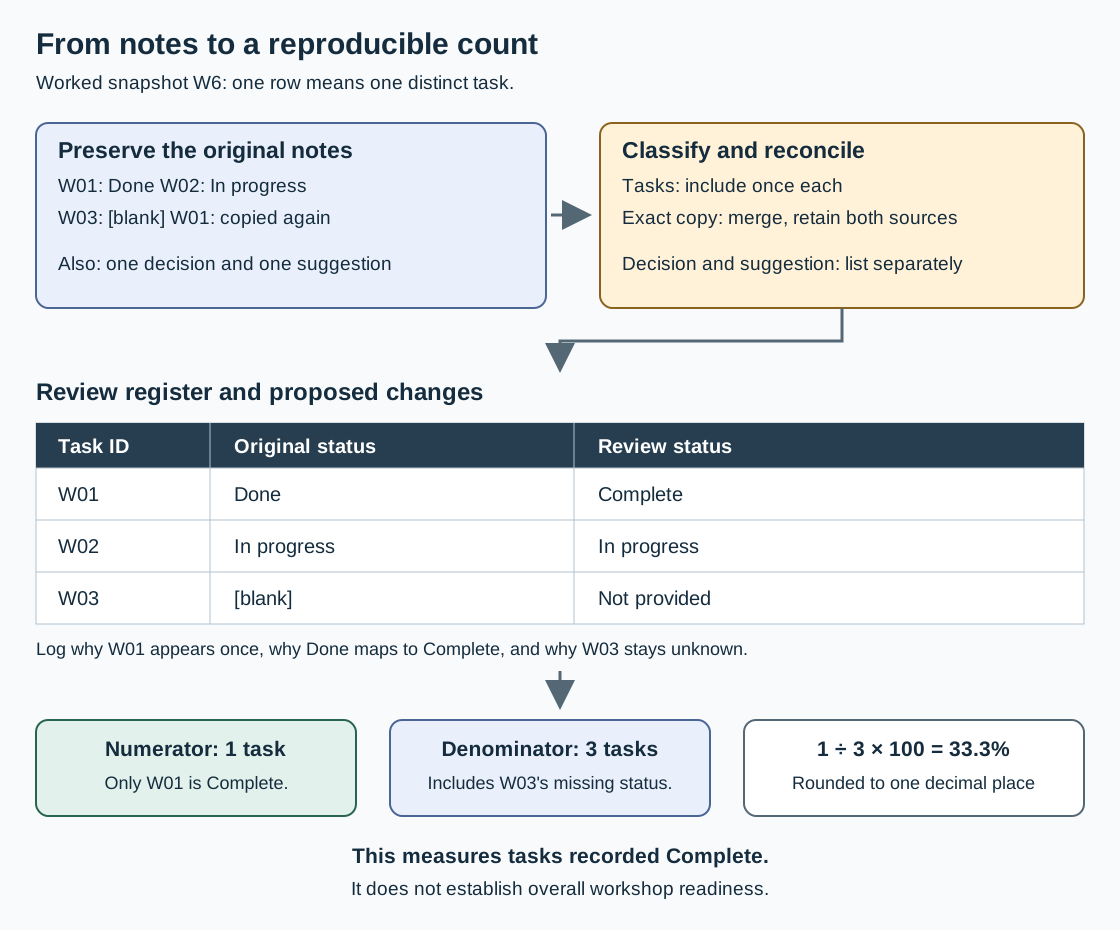
[A flow from original notes through classification, a review register and a change log to an explicit count. The example counts one Complete task out of three distinct tasks, includes one missing status in the denominator, and reports 33.3 percent.]
Text equivalent of the diagram
- Preserve the original notes.
- Classify each entry. Agreed tasks enter the register; decisions and unaccepted suggestions are listed separately.
- Match exact duplicate mentions, keep one task row and retain all supporting source labels. Keep unknown fields visible.
- Preserve original values and record proposed standard labels in a review register and change log.
- For worked snapshot W6, include W01, W02 and W03: three distinct tasks. The repeated copy is not a fourth task. The decision and suggestion are excluded.
- Only W01 is recorded Complete. W03 has missing status and stays in the denominator.
- Calculate 1 divided by 3 multiplied by 100, then round to one decimal place: 33.3%. This is the proportion of included tasks recorded Complete, not a measure of overall readiness.
Copyable extraction and checking prompt
Create a review task register from the fictional notes I provide. Use only those notes. Preserve the originals. Separate agreed or required actions, decisions and unaccepted suggestions. Use one row per distinct task. Do not invent owners, deadlines, dependencies or statuses.
Columns: Task ID; Action; Owner; Due; Dependency; Original status; Review status; Source. Use Not provided for absent values and show an original blank status as [blank]. Preserve None recorded when the source lists no dependency. Retain all source labels for any merged duplicate.
Apply only the status dictionary I provide. List proposed changes with original values, proposed handling and reasons. Identify every duplicate, blank and unfamiliar label. If repeated IDs conflict, flag the conflict instead of choosing a version.
Reconcile every source entry to a register row or a clearly explained exclusion. Then count each distinct task once, including tasks with missing status in the denominator. Count only review status Complete in the numerator. Give both counts, the included and completed task IDs, the missing-status count, and the division and multiplication. Round the final percentage to one decimal place. Do not edit a live record or send anything.
Source notes — current fictional snapshot [Paste the entire current source pack here.] End of source notes
Status dictionary [Paste the full supplied dictionary here.]
Replace both placeholders before running the prompt. Save the complete prompt. An assistant’s count is a candidate answer; check the row coverage and arithmetic yourself.
Read the diagram explanation
Worked snapshot W6 has four task mentions, including a repeated W01, plus a decision and a suggestion. Reconciliation produces three distinct task rows. W01 is Complete, W02 is In progress and W03 has missing status. Originals and proposed changes are retained. The completed count is one; the denominator is three and includes the missing-status task. One divided by three times one hundred is 33.3 percent to one decimal place.
Reading progress
47 lessons remain open to guests. Marking a lesson read records reading only; it does not award assessment credit or a certificate.
Device reading marks require browser storage. Reading is always available.
Sign in or create an account to save separate account progress. Your current page is kept.
Your earlier place on this device suggests these lessons. No new lesson is marked read.